Why Your Global Team Thinks They're Aligned After Every Meeting (And What's Actually Happening)
Most global teams walk out of meetings thinking everyone agrees. Two weeks later nothing has moved. Here's the invisible cultural gap nobody is naming.
By Jay Vergara
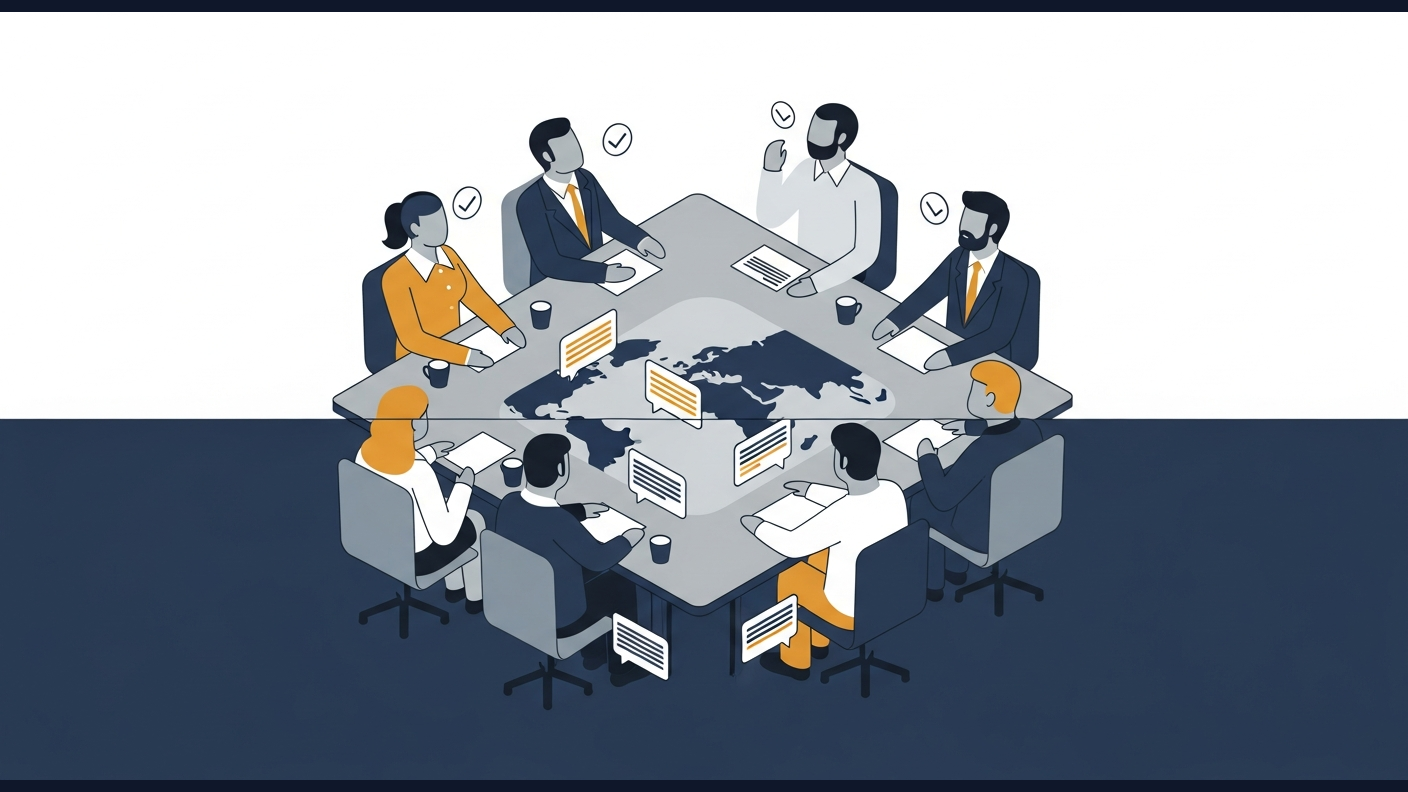
A scene plays out in global companies every single week.
The team gathers on a video call: Toronto, Tokyo, Singapore, maybe Manila. The project lead walks through the plan. People nod, a few questions come in, the meeting ends, and everyone leaves feeling aligned.
Two weeks later, nothing has moved. The Tokyo team went back and discussed the plan among themselves and decided it needed changes, but they didn’t surface that in the meeting. The Singapore team assumed silence from Tokyo meant agreement. Toronto moved forward on the original plan. Now everyone is confused about why things are stalled.
The dynamic is more cultural logic than communication failure, and naming it correctly is what unlocks the fix.
The invisible gap: how cultures process decisions differently
Sahadevan and Sumangala (2021) found that one of the biggest barriers in cross cultural business communication is the assumption that everyone is operating under the same communication rules, more than language itself.
Different cultures have fundamentally different expectations about how decisions get made, how disagreement gets expressed, and what silence means.
In many Western business cultures, especially in North America, decisions happen in the meeting. You discuss, you debate, and you decide. If someone doesn’t speak up, it gets assumed they agree. This is ‘low context’ communication. The words carry the meaning.
In many East Asian and Southeast Asian business cultures, the meeting is often a formality. The real decision making happens before or after the meeting through informal conversations, relationship building, and consensus gathering.
In Japan, this process has a name: ‘nemawashi,’ which literally means “going around the roots.” It is the practice of building agreement quietly and individually before the group ever sits down together.
Neither approach is wrong. When you put them in the same meeting without acknowledging the difference, you get the illusion of alignment in place of the actual thing. Somebody usually has to name it from the outside, which is where an outside read on how your team makes decisions earns its keep.
What ‘nemawashi’ teaches us about real alignment
‘Nemawashi’ is about respect, more than about politics or going behind people’s backs. In ‘high context’ cultures, putting someone on the spot in a group setting can feel confrontational. Disagreeing publicly with a senior leader can feel like a breach of trust. The work of alignment happens in smaller, quieter conversations first.
Mushaathoni (2025) proposed an intercultural communication management framework that emphasizes this exact point. Effective global teams translate processes across cultures, more than just words, and they recognize that what looks like agreement in one culture might actually be “I need to think about this and discuss it with my team before I can commit.”
Zhang and colleagues (2022) studied how language based subgroups within global teams navigate meetings. They found that when dominant language speakers control the pace and structure of meetings, non native speakers and culturally different team members often disengage. The cause is structural rather than motivational. The format doesn’t create space for them to say what they are thinking, even though they have plenty to contribute.
What actually closes the gap
If you lead a global team, four practices close the alignment gap meaningfully.
Separate the discussion from the decision. Stop expecting every meeting to end with a decision. Use meetings to share information and surface questions, then give teams time to process. Set a follow up window where people can share input asynchronously before the decision is finalized. The window gives ‘high context’ team members the space they need to do their own version of ‘nemawashi.’
Ask for disagreement explicitly. In many cultures, disagreement won’t surface unless you create a direct invitation for it. Try asking: “What concerns haven’t we raised yet?” or “What would make someone hesitant about this plan?” Frame it as a team norm rather than putting any one person on the spot. When you make it safe to push back, you get real alignment in place of surface agreement.
Use written pre reads and post meeting summaries. Send materials before the meeting so people have time to think. After the meeting, send a written summary of what was discussed, what was decided, and what still needs input. The summary creates a shared artifact that everyone can respond to on their own terms and in their own time. Zhang et al. (2022) found that this single practice significantly improved participation from non dominant language speakers.
Build relationship time into the process. In ‘high context’ cultures, trust is built through relationship, more than through task completion alone. Skipping the relationship building and going straight to deliverables leaves you working with surface level commitment. Schedule informal checkins. Ask how people are doing before jumping into the agenda. Visit in person when you can. The investment in relationship pays dividends in honest communication later.
Sometimes the most important thing said in a meeting is the thing nobody said out loud.
Frequently Asked Questions
Q: Why do global teams think they’re aligned after meetings when they aren’t?
Sahadevan and Sumangala (2021) found that the biggest barrier in cross cultural business communication is the assumption that everyone is operating under the same decision making rules, more than language itself. In North American business culture, silence in a meeting typically means agreement. In many East Asian cultures, the meeting itself is often a formality, and the real decision making happens before and after through quieter individual conversations. When both groups leave the same meeting, they genuinely believe they understood each other.
Q: What is ‘nemawashi’ and how does it affect global team decisions?
‘Nemawashi’ is a Japanese practice of building agreement quietly and individually before a group sits down together. It literally means “going around the roots.” Mushaathoni (2025) found that effective global teams translate processes across cultures, more than just words, recognizing that what looks like silence or delayed commitment in one cultural framework is actually a structured and respectful path to genuine consensus. Skipping that process doesn’t speed things up. It creates the illusion of alignment that collapses two weeks later.
Q: Why do non native speakers and team members from certain cultures go quiet in global meetings?
Zhang and colleagues (2022) studied this directly and found that when dominant language speakers control the pace and structure of meetings, culturally different team members often disengage. The cause is structural rather than motivational. The format doesn’t create space for them to say what they are thinking. In ‘high context’ cultures, raising concerns publicly or disagreeing with a senior person in a group setting can feel confrontational in a way that ‘low context’ participants don’t register at all.
Q: How do you get honest disagreement from team members who won’t push back in meetings?
The research from Mushaathoni (2025) and Zhang et al. (2022) suggests two things work: separating the discussion from the decision so teams have time to process asynchronously, and explicitly naming disagreement as something the team wants to hear. Asking “What concerns haven’t we raised yet?” or “What would make someone hesitant about this plan?” reframes pushback as a team norm rather than a challenge to authority. Written pre reads and post meeting summaries also give team members a channel to respond on their own terms.
If you’re leading across cultures, the work involves rethinking how decisions get made when the people making them come from fundamentally different communication traditions, more than just translating your process into other languages. For a closer look at how language itself shapes these gaps, I explored the words that don’t translate across cultures and what they reveal about how teams actually think.
We help organizations bridge these exact gaps through our cross cultural leadership services, team workshops, and organizational consulting. If you want to dig deeper into the communication dynamics, I also wrote about what the silence in your global meetings is really saying and why most cross cultural training doesn’t change behavior.
Sources

by Jay Vergara
Partner, Lead Learning Consultant at Peak Potential Consulting
L&D strategist and cross cultural communication specialist helping organizations build leaders, teams, and learning cultures that work across borders. Currently pursuing his MBA at GLOBIS University in Tokyo.