Your Global Team Isn't Broken. It's Speaking Two Different Languages.
Most global teams know cultural differences exist, but few have a shared language for them. What the research says, and four practices that actually help.
By Jay Vergara
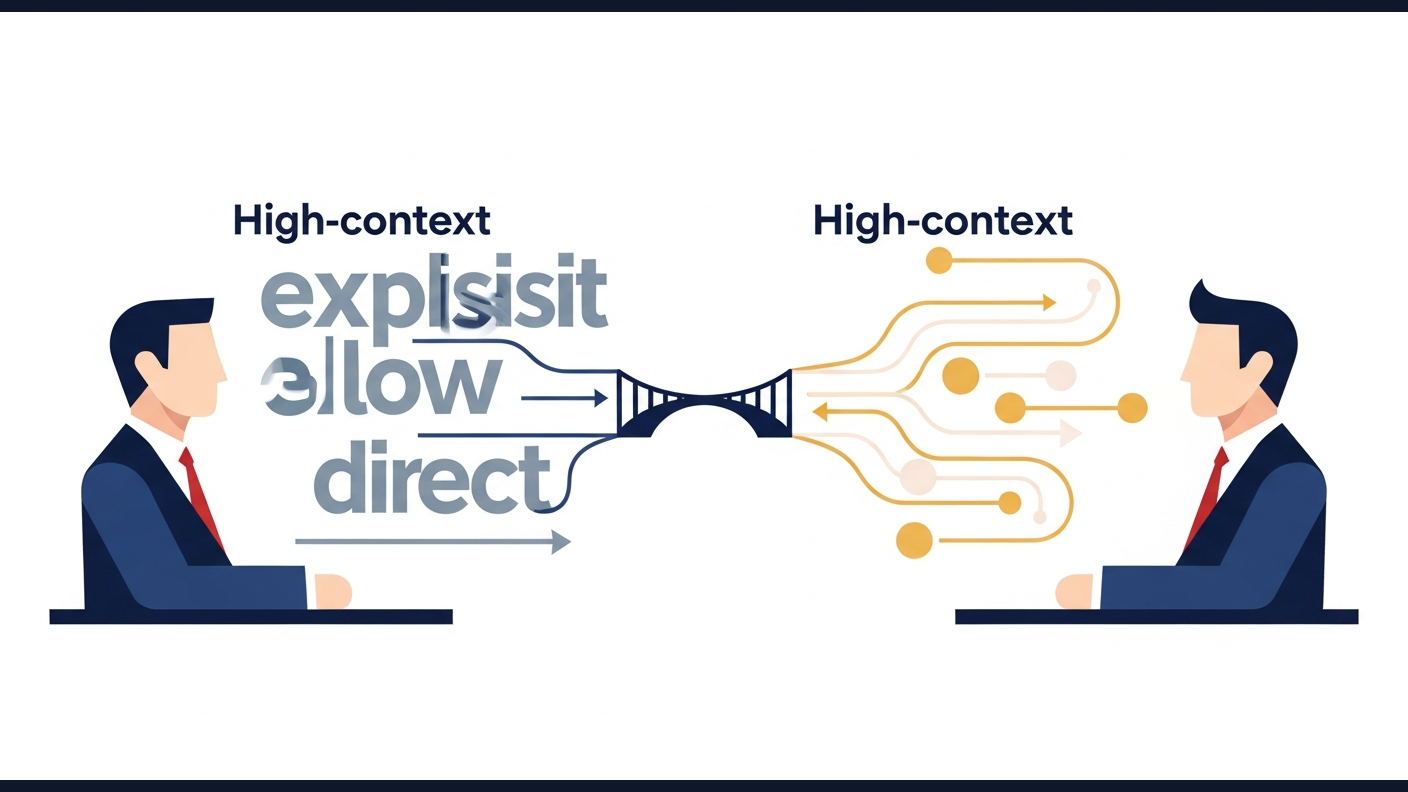
A team that looks great on paper, smart people with clear goals and good intentions, somehow keeps stalling, with deadlines slipping and tensions building and nobody able to explain why.
Watching this play out in enough rooms is humbling. The disorientation when a talented team can’t seem to get out of its own way comes from somewhere specific, and the usual suspects rarely name it correctly. “We need better project management.” “We need clearer roles.” “We need more meetings.” The deeper pattern is that the team is operating with two completely different communication systems and nobody on it has named the difference out loud.
This goes beyond language proficiency. Everyone might speak English fluently. The problem sits at the level of meaning, and the gap between how different cultures create, share, and interpret meaning is one of the most underestimated challenges in global business.
The framework: high context vs. low context communication
In 1976, anthropologist Edward T. Hall introduced a framework that remains one of the most useful tools for understanding cross cultural communication. He described cultures as falling on a spectrum between ‘high context’ and ‘low context.’
‘Low context cultures’ (think the United States, Canada, Australia, Germany, the Netherlands) put the meaning in the words. Communication is explicit, direct, and literal. If something matters, you say it clearly. Silence tends to get interpreted as agreement or disengagement, feedback is given directly, and contracts and written documentation carry significant weight.
‘High context cultures’ (think Japan, China, Korea, many Southeast Asian and Middle Eastern cultures) put the meaning in the context around the words. Tone, timing, relationship, hierarchy, body language, and what isn’t said all carry as much meaning as what is said. Silence can mean respect or disagreement or contemplation or deference, and feedback tends to be indirect because relationships and trust carry more weight than formal agreements.
Neither style is better. Both are sophisticated systems for communicating effectively within their own cultural context. The problem shows up when they collide in a global team without a shared framework for navigating the difference.
Why cultural intelligence matters more than cultural awareness
Most organizations have some version of “cultural awareness” training. People learn about holidays, customs, and etiquette. The training is a start, and on its own it doesn’t go far enough.
Bucker and colleagues (2024) developed and validated a scale for measuring ‘team cultural intelligence,’ which they define as a team’s collective ability to function effectively in culturally diverse settings. Their research shows that cultural intelligence is a team capability that can be developed, more than an individual trait alone.
The Cultural Intelligence Center has compiled decades of research showing that teams with higher CQ (cultural intelligence quotient) outperform those with lower CQ on virtually every measure: innovation, decision quality, employee satisfaction, and retention. The key finding: CQ comes from the metacognitive skills to recognize when cultural differences are at play and the behavioral flexibility to adapt in real time, more than from accumulating facts about other cultures.
The distinction matters in practice. Knowing that Japanese business culture values harmony is different from being able to recognize, in a live meeting, that your Tokyo colleague’s polite agreement might mean “I have serious concerns but this isn’t the right setting to raise them.”
What this looks like in practice
A common pattern. A product team has members in San Francisco and Osaka. The San Francisco team presents a new feature roadmap in a group call. They ask for feedback. The Osaka team says it looks good and asks a few clarifying questions. The San Francisco team moves forward.
Three weeks later, the Osaka team surfaces major concerns through their manager, who raises them with the product lead in a private conversation. The San Francisco team is frustrated. “Why didn’t they say something in the meeting?”
The answer is that they did. They asked clarifying questions, which in a ‘high context’ communication style is often a way of signaling concerns without directly challenging the presenter in a group setting. The San Francisco team, operating in a ‘low context’ mode, interpreted those questions at face value rather than reading the context around them.
(Watching this play out in real time is almost funny. Both sides genuinely think they communicated perfectly.)
Neither team did anything wrong. They were both communicating effectively within their own cultural framework. The gap was the absence of a shared language for bridging the two.
Four practices that close the gap
Teach the framework explicitly. Give your team the language of ‘high context’ and ‘low context’ communication. When people have a shared framework, they can name what’s happening in the moment in place of making assumptions about intent. If you want something more precise than a two category model, a communication style assessment that scores the individual hands everyone a profile instead of a stereotype. “I think we might be in a high context / low context gap right now” is a powerful sentence that turns confusion into curiosity.
Build cultural intelligence as a team skill. Send individuals to cultural training when it makes sense, and work on CQ together as a team alongside it. Discuss real scenarios from your own work, asking questions like “When have we misread each other’s signals?” and “What does agreement actually look like for each of us?” The research from Bucker et al. shows that team level CQ develops through shared reflection, more than through individual study alone.
Create multiple channels for input. If your team’s only forum for raising concerns is a live video call, you are structurally disadvantaging ‘high context’ communicators. Create space for written input before and after meetings. Use anonymous surveys for sensitive topics. Offer one on one conversations as an alternative to group discussion. The goal is to make sure the meeting isn’t the only place where real communication happens.
Slow down at key decision points. When a major decision is on the table, don’t rush to close. Name the decision, share the relevant information, and then create a 24 to 48 hour window for people to reflect and respond. This gives ‘high context’ team members time to process, consult with colleagues, and share their perspective in a way that feels comfortable. It also tends to produce better decisions for everyone, regardless of cultural background.
The best global teams have learned to hear what wasn’t being said, and they treat friction as a signal worth investigating rather than a problem to suppress.
If you want to see what this looks like at the language level, I wrote about untranslatable words and why they unlock cultural understanding in a way that frameworks alone can’t.
Frequently Asked Questions
Q: What is the difference between high context and low context communication?
Edward T. Hall introduced this framework in 1976 to describe how cultures encode meaning. In ‘low context’ cultures like the United States and Germany, meaning lives in the words themselves and communication is meant to be explicit and direct. In ‘high context’ cultures like Japan and Korea, meaning is carried by tone, relationship, hierarchy, and what isn’t said. Neither system is better, and when they collide in a global team without a shared framework, the misreads compound fast.
Q: What is ‘cultural intelligence’ and how is it different from cultural awareness?
Cultural awareness means knowing facts about other cultures, their customs, holidays, and etiquette. Cultural intelligence, or CQ, is the ability to recognize in real time when a cultural gap is happening and adapt your behavior accordingly. Bucker and colleagues (2024) validated a team level CQ scale showing that this is a collective capability that develops through shared reflection and practice, more than through individual study or one off training sessions alone.
Q: Why do global teams keep misunderstanding each other even when everyone speaks English?
Language proficiency rarely is the issue. Different cultures use completely different systems for signaling agreement, expressing concern, and interpreting silence. In a ‘low context’ meeting, silence means agreement or disengagement. In a ‘high context’ meeting, silence might mean respect, contemplation, or serious concern that isn’t appropriate to raise publicly. The Cultural Intelligence Center’s research shows that teams with higher CQ outperform lower CQ teams on innovation and decision quality precisely because they don’t mistake surface communication for real alignment.
Q: How do you get honest input from team members who don’t speak up in group meetings?
The research from Bucker et al. (2024) shows that ‘high context’ communicators often need multiple channels beyond a live group call to share their real perspective. Creating written pre reads, post meeting summaries, and anonymous input options gives team members who prefer to reflect before responding the space they need. The goal isn’t to change how people communicate. The goal is to make sure the group meeting isn’t the only place where real input can happen.
If your team keeps running into invisible walls, we help organizations build cross cultural communication habits that transfer directly to the work. Our cross cultural leadership services use the Intrivity MRTS Assessment to give teams a shared language for these differences. You can also explore our workshops or get in touch.
For more on how these dynamics play out in specific situations, I wrote about what the silence in your global meetings is really saying and why most cross cultural training doesn’t actually change behavior.
Sources

by Jay Vergara
Partner, Lead Learning Consultant at Peak Potential Consulting
L&D strategist and cross cultural communication specialist helping organizations build leaders, teams, and learning cultures that work across borders. Currently pursuing his MBA at GLOBIS University in Tokyo.