Working With Japan · Module 2 of 7
Map the Gap
Plot the five dimensions where you and your Japanese counterparts actually differ, and turn the distance into a short list of work.
By the end of this one
10 min read
You'll be able to:
- Plot yourself and the team you actually work with on all five Culture Map scales, then measure the distance between your two marks.
- Circle your two or three widest gaps and pick one move you will practice for each.
- Take a misunderstanding you had recently and name which of the five dimensions caused it.
Before you start
What stuck from last time
Three questions on Module 1: How Culture Works. Pulling it back out of memory is what makes it stick, and that beats re reading the module. Nothing here gets saved or scored.
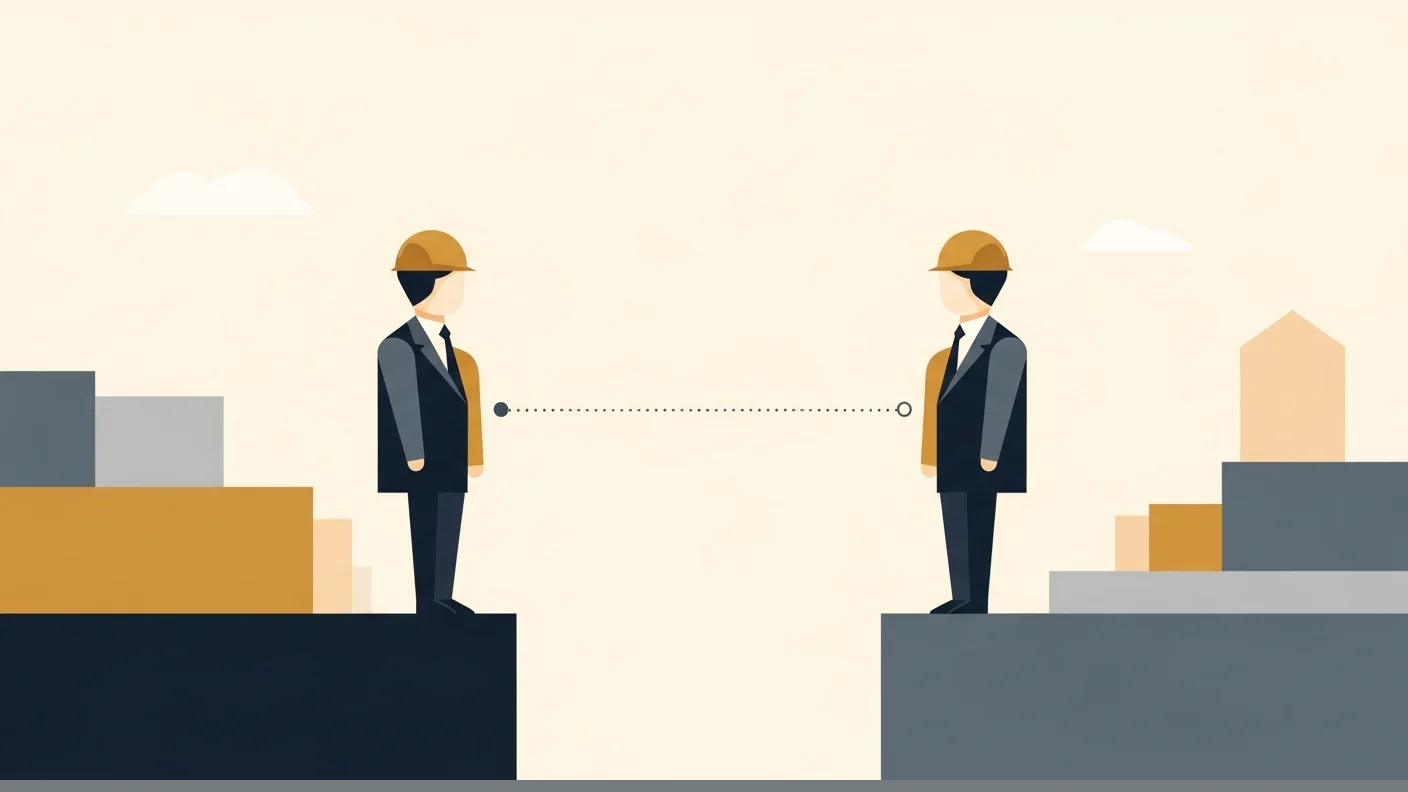
A culture gap is the distance between your default way of working and your counterpart's default way of working, measured one dimension at a time. Communication, feedback, hierarchy, trust, and disagreement each carry their own distance. Mapping them turns a vague sense that Japan is different into a short list of specific work.
Module 1 explained why your reflexes were trained somewhere else and gave you the Pause Loop for the moment they misfire. This module shows you where the misfires will cluster. Once you can see which gaps are actually yours, you can drop the general preparation and practice the two or three that matter.
The map we use comes from Erin Meyer's The Culture Map (2014), built from her research at INSEAD. She plots work cultures along eight scales; we use the five where the Japan gap does the most damage in a foreigner's first year.
How to read the map
Each scale below is a line with two ends, and countries sit at positions along it. What matters is never your absolute position but the distance between you and the person across the table. A German and an American are both direct by Japanese standards, yet the American still finds the German blunt, because gaps are relative.
One caution before you plot anything. The positions describe averages, so your actual counterpart may sit anywhere near them, and a Japanese colleague with ten years in New York may be more direct than you. It's a map, not a verdict.
The five dimensions
Communicating: low context to high context
Low context cultures treat the message as the words, so good communication is explicit, precise, and repeated. Japan sits at the far high context end of Meyer's scale, where the message is the words plus the relationship plus the setting. Much of what's said in a Japanese meeting travels around the words rather than in them.
The phrase to learn first is 'that might be difficult', which translates as no. So do 'we will consider it', a sharp intake of breath, and a long pause followed by a topic change. The soft no is a courtesy that lets everyone keep face, and reading it is a trained skill rather than a universal one: in one experiment, Chinese raters could identify indirect replies from both their own culture and British speakers, while British raters could only read the British ones (Pang et al., 2024).
The move. When you hear softness, don't push for a hard yes or no in the room. Ask a sideways question later, in a 1:1, where honesty costs less.
Evaluating: how negative feedback travels
Japan softens negative feedback further than almost anywhere. Criticism arrives wrapped, delayed, and often carried by context instead of words.
Treat lukewarm praise as the criticism, and that one rule saves people months. If your presentation earns 'the data section was very thorough' and nothing else, listen for what was NOT praised, because the silence around the compliment is the message.
The move. After any review, write two columns: what was praised and what was skipped. The skipped column is your feedback.
Leading: egalitarian to hierarchical
Japanese organizations run on 'senpai' and 'kohai', senior and junior, and the hierarchy is relational as much as structural. Deference flows up, protection flows down, and the chain matters more than the org chart suggests.
Never go around your boss, and this is the one rule with no exceptions. An engineering lead we trained emailed his boss's boss directly to speed up an approval, and the approval did come quickly. His manager had been publicly humiliated by the bypass, and repairing that relationship took six months.
The move. When you need speed, ask your boss to escalate and make it easy: 'Would it help if I drafted something you could send up?'
Trusting: task based to relationship based
In most Western workplaces competence opens the door, so deliver twice and people trust you. In Japan the relationship opens it first, and competence is what keeps it open.
That's why 'nomikai', the after work dinner or drinks, does real professional work. Since the pandemic, attendance is far more optional than it used to be, and nobody serious expects you at everything. Declining everything is different: a specialist we worked with turned down every invitation for a year, and while nobody ever criticized him for it, his budget requests kept stalling while a peer's kept sailing through.
The move. Accept sometimes, and if evenings don't work for you, build the relationship in daylight. Lunches, coffee, and ten minute non work conversations compound the same way.
Disagreeing: confrontational to conflict avoiding
Japan sits at the conflict avoiding end, because open disagreement in a meeting risks 'wa', the group harmony from Module 1. Disagreement still happens constantly, just in private and in advance, one conversation at a time.
A team we supported pitched a strong proposal, got a polite yes in the meeting, and then watched it die for three weeks. Nobody had disagreed in the room, and nobody executed after it, because the real decision conversations never happened.
The move. Treat the meeting as the last step of a decision rather than the first. Module 4 teaches 'nemawashi', the private alignment work, in full.
Voice and harmony
One pattern sits under all five scales, and Amy Edmondson's psychological safety research gives it a name. In low context cultures, speaking equals competence and silence equals risk, so you talk to show you're engaged. Japan runs the reverse, where speaking carries the risk and silence is the safe option, and you hold back to show respect and to protect the room.
Neither side is wrong, but the collision is expensive. The foreigner reads the quiet Japanese team as disengaged, the Japanese team reads the talkative foreigner as careless, and both are misreading the same signal. Research on employee voice supports designing around this rather than exhorting people to speak up, because what enables voice is a context that makes speaking safe (Morrison, 2023).
Four things work here. Hold 1:1s where the social cost of candor drops, open written channels because plenty of people will write what they'd never say aloud, invite input explicitly and by name since 'any questions?' invites nobody, and treat silence as data rather than absence.
This module's tool
The Personal Gap Map
- 1.
Draw the five scales. Communicating, Evaluating, Leading, Trusting, Disagreeing, each as a line with two ends.
- 2.
Plot yourself. Honestly, as you work under pressure, not as you'd like to be.
- 3.
Plot your counterpart team. The actual people you work with, not the national average.
- 4.
Circle the widest gaps. Usually two or three. The size of the gap is the size of the work.
- 5.
Pick one move per circled gap. Use the moves from this module and practice them for a month.
Ignoring the gap is the default. Working with it takes a decision, and the people who make that decision become the rare bridge both sides trust to translate. What you're building is range rather than a Japanese persona, and you'll be more effective as an expanded version of yourself than as a half Japanese imitation.
Watch: the trusting dimension in depth
Head trust and heart trust, the two currencies behind the trusting scale, from our channel.
Try this week
Plot your own map
Open the Personal Gap Map worksheet and plot yourself on all five scales, then plot the counterpart team you work with most. Circle your widest gaps and pick one move for each.
Keep the map somewhere you'll see it, because the rest of this course keeps returning to it. Modules 3 through 6 each train one of the gaps you just circled.
Your printable for this module
The Personal Gap Map
A printable worksheet with all five scales laid out, ready for you to plot yourself and your counterpart team and circle the gaps worth working on.
Get the worksheet →
For the communicating scale specifically, the Communication Style Map gives you an interactive way to place yourself and your colleagues.
Before you go
Common questions
What is The Culture Map?
The Culture Map is Erin Meyer's 2014 framework, built from her research at INSEAD, that plots national work cultures along eight behavioral scales. This course uses the five scales where the gap between Japan and most Western business cultures does the most practical damage: Communicating, Evaluating, Leading, Trusting, and Disagreeing. What matters on every scale is not your absolute position but the distance between you and your counterpart.
Does every Japanese colleague fit the Japanese end of each scale?
No. The positions describe averages, and individuals sit anywhere around them. A Japanese colleague who spent a decade in New York may be more direct than you are. That is why we say it is a map, not a verdict: use it to form a first hypothesis, then plot the actual people you work with and update as you learn them.
Do I have to attend nomikai to build trust in Japan?
No, and since the pandemic attendance has become far more optional than it used to be. But declining every invitation reads as declining the relationship itself, because in Japan trust is built relationship first. If evenings do not work for you, build the same trust in daylight: lunches, coffee, and short non work conversations compound the same way.
Should I try to act Japanese?
No. The goal of gap work is range: keeping your own style and adding the ability to shift toward your counterpart when the situation calls for it. You will be more effective as an expanded version of yourself than as a half Japanese imitation, and most Japanese colleagues find the imitation uncomfortable anyway.
Prefer to work through this live? We teach this module in workshops for relocating executives and global teams. See how we work or email us.
About this module
Written and designed by Peak Potential Consulting, and free to use. Print it, share it with your team, and keep the credit with it. If you quote or adapt it, name us and link back. For use inside a paid training programme, talk to us first.
© 2026 Peak Potential Consulting · peakpotentialconsulting.com · hello@peakpotentialconsulting.com